Phú Thọ’s two-tier local government model sees results
- Date modified:8:58, 18/7/2026
After one year of operating under the two-tier local government model in Phú Thọ Province, coordination between local authorities and provincial departments has become well established, allowing work to be handled far more efficiently.
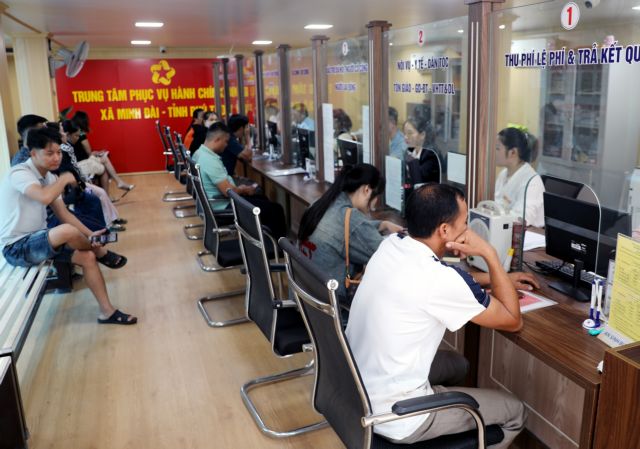 |
Local residents at the Public Administration Service Centre in in Minh Đài Commune, the northern province of Phú Thọ. — VNA/VNS Photo Tạ Toàn |
PHÚ THỌ — More than a year after the northern province of Phú Thọ officially began operating under the two-tier local government model, the new administrative system has gradually settled into stable and effective operation.
Chu Văn Thắng, chairman of the People's Committee of Lương Sơn Commune, said the transition initially placed enormous pressure on local authorities, with the commune's workload increasing by several times.
Responsibilities ranging from land administration, construction management and social welfare to handling petitions and complaints were all transferred to the commune level.
"But that pressure has also been a catalyst for growth," he said.
After more than a year, coordination between local authorities and provincial departments has become well established, allowing work to be handled far more efficiently.
More importantly, the reform has brought about a fundamental shift in governance, Thắng added.
“Commune-level authorities previously focused largely on carrying out administrative procedures under a traditional management model. They are now taking a far more proactive approach, placing residents at the centre of public service delivery,” he said.
Following the historic merger of the former provinces of Phú Thọ, Vĩnh Phúc and Hòa Bình into the new Phú Thọ Province, the number of specialised administrative agencies across the province was reduced dramatically, from 91 to just 26.
Alongside this streamlining, the management capacity of local officials has improved significantly.
One of the most notable achievements during the first year has been the province's progress in administrative reform and digital transformation.
Phú Thọ is now among the country's leading localities in operating commune-level Public Administration Service Centres while maintaining its green status on the national public service portal.
The province has standardised more than 2,092 administrative procedures and successfully introduced a system allowing residents to submit applications regardless of their places of residence within the province.
At the Public Administration Service Centre in Hùng Vương Ward, procedures related to land administration, business registration and civil matters have become considerably more convenient.
Many appraisal procedures are now completed directly at the local level, with data integrated seamlessly into the provincial digital system.
Residents can monitor the progress of their applications using QR codes or receive completed documents via postal services.
As a result, more than 99 per cent of administrative applications in many localities are now processed on or ahead of schedule.
Võ Miếu Commune resident Hà Thị Thu Hằng said administrative procedures are now explained much more clearly, while many applications can be submitted online, significantly reducing travel time and costs.
Hà Văn Chúc, a resident of Minh Đài Commune, said that many people had initially worried that the abolition of district-level administration would make procedures more complicated.
"In reality, the opposite has happened," he said.
Many procedures are processed more quickly, and officials provide much more thorough guidance.
"People are very supportive of the new model," he added.
Closer to the people
Rather than simply waiting for residents to visit administrative offices, many local authorities have taken a more proactive approach by working directly within communities to identify and resolve issues before they escalate.
Over the past year, the province has established 26 working groups that regularly visit communes and wards to address difficulties and gather feedback from communities.
In Vân Phú Ward, officials have been instructed to maintain a thorough understanding of local conditions and resolve issues as close to the community level as possible, minimising administrative backlogs.
Ward resident Nguyễn Văn Ninh said administrative procedures are now much simpler and faster than before, with officials providing detailed guidance and significantly reducing unnecessary intermediary steps.
The same approach has proved effective in Mường Vang Commune.
Formed through the merger of three former communes, Mường Vang is home to more than 20,900 people, nearly 98.5 per cent of whom belong to the Mường ethnic group.
Mass organisations, village heads, respected community heads and Community Digital Technology Teams have all played an active role in raising public awareness, helping residents access digital public services and conveying local concerns to the authorities.
As a result, many emerging issues have been resolved at an early stage.
Between July 2025 and June 2026, the commune held 125 citizen reception sessions and successfully resolved all 56 petitions and complaints relating to social welfare, environmental issues and community livelihoods.
During the same period, local authorities processed more than 3,400 administrative applications, all within the prescribed timeframe, achieving a 100 per cent public satisfaction rate.
In the first six months of this year alone, the commune activated more than 13,600 Level-2 electronic identification accounts, equivalent to nearly 83 per cent of eligible residents.
Quách Tuấn Phong, chairman of the People's Committee of Mường Vang Commune, said the success of the two-tier local government model in mountainous areas rests on public consensus and the strength of grassroots political institutions.
"When people have confidence in the authorities, Government policies can be implemented much more effectively," he said. "Local administration must remain close to the people, understand their needs and genuinely serve their interests."
Chairwoman of Lương Sơn Commune's Việt Nam Fatherland Front Committee Thúy Hòa said the new model is helping build a leaner, more efficient administration that better serves local communities.
"We are fully aware of that responsibility, which is why we devote considerable time to meeting residents and listening to their concerns," she said. — VNS