Officials and academics push ‘three-party linkage’ to modernise agriculture
- Date modified:15:30, 15/5/2026
Việt Nam’s agriculture sector must move beyond maximising output and focus on value creation, technology and sustainability, experts said at a conference on Thursday.
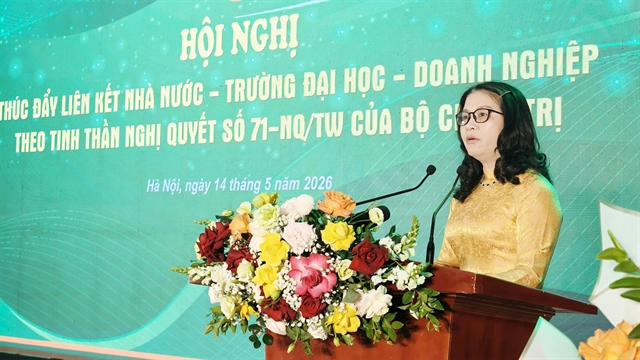 |
Nguyễn Thị Lan, director of the Vietnam National University of Agriculture, speaks at the conference on Thursday. — VNS Photo Trần Như |
Trần Như
HÀ NỘI — Officials and academics have called for deeper collaboration among the Government, universities and enterprises to drive technological innovation and workforce development in agriculture, warning that years of research investment have yielded too few commercial results.
The appeal came at a conference organised by the Vietnam National University of Agriculture on Thursday, which focuses on advancing the tripartite partnership model under Politburo Resolution 71.
Deputy Minister of Agriculture and Environment Nguyễn Quốc Trị told attendees that science, technology and skilled labour will be decisive factors in the sector's competitiveness as Việt Nam navigates the twin demands of a green and digital economy.
He urged universities to pivot toward entrepreneurial, innovation-driven models, emphasising hands-on training and technological adaptability while calling on enterprises to treat academic institutions as strategic partners rather than simply a pipeline for graduates.
"Enterprises must actively commission research, participate in curriculum design, accept interns and invest in research and development," Trí said.
The ministry has identified biotechnology, seed technology, digital agriculture, artificial intelligence, big data and environmental technology as priority areas.
Trí encouraged all parties to build joint research programmes, shared laboratories, innovation centres and technology demonstration sites tied to the actual needs of local communities and businesses.
Those priorities, he said, align with Resolution 85, which sets a broader national goal of building a modern, high-productivity agricultural sector capable of sustaining export growth, elevating farmers' economic standing and developing resilient rural communities in the face of climate change.
Nguyễn Văn Long, director of the Science and Technology Department at the Ministry of Agriculture and Environment, said the sector has been assigned a growth target of 3.6 to 4 per cent and that innovation must be the engine to reach it.
He noted that while the ministry carried out more than 1,200 ministerial-level research projects between 2021 and 2025, only a small fraction of the resulting products were successfully commercialised – a gap he described as one of the sector's most pressing bottlenecks.
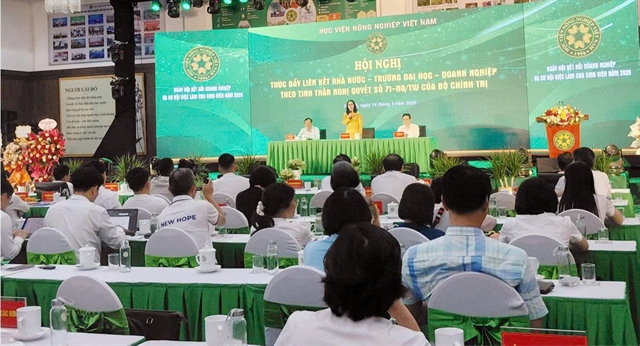 |
The conference on Thursday. — VNS Photo Trần Như |
Ngô Trí Long, a former director of the Market and Price Research Institute under the Ministry of Finance and a prominent economics expert, said the most significant conceptual shift embedded in the resolutions is the move from an 'agricultural production' mindset to an 'agricultural economy' mindset.
"This means the sector must move beyond maximising output and instead create greater value through branding, deep processing, integrated supply chains and meeting international standards," he said.
He identified several long-standing structural obstacles, including fragmented landholdings, loose coordination among farmers, cooperatives and enterprises and underdeveloped logistics and food processing infrastructure.
He also flagged weak implementation capacity at the local level, arguing that the priority now is not more policymaking but more effective execution with clear assignments, clear accountability and results-based oversight mechanisms.
Environmental pressures added further urgency to the discussion.
Experts said modern agricultural development can no longer pursue output growth at any cost and must be tightly linked to environmental protection, including land and water resource management, the restoration of mangrove and protective forests and reduction of rural pollution.
Nguyễn Thị Lan, director of the Vietnam National University of Agriculture, said the challenges of green transition, circular agriculture, emissions reduction, digitalisation and greater value-added production in an era of deeper global integration cannot be solved by any single actor working alone.
"The Government cannot only issue policy. Universities cannot only teach in classrooms. Businesses cannot only hire at the end of the training pipeline," Lan said, calling for a fundamentally deeper model of joint action across all stages of training, research, innovation and workforce development.
The university has piloted several partnership programmes in recent years, including company-commissioned training, joint curriculum development and student internships at farms, raw material zones and cooperatives.
But Lan and other conference speakers said the next phase requires businesses to engage far upstream, from identifying labour needs and shaping research agendas to co-developing technology and bringing it to market.
One speaker proposed a 'co-design, co-develop, co-train' model and called for targeted support mechanisms in fields facing critical labour shortages, including animal husbandry, veterinary science, fisheries and maritime economics. — VNS